Measure wall length and retained height.
Enter the wall length as the project length, backfill thickness as width, and wall height as depth. Set all three dimension units to feet for a direct backfill estimate.
Verified formulaEditable presetsUS + metric
Purpose-built estimator
Project measurements
Total wall length along the face.
Backfilled wall height used for drainage rock.
Depth of clean stone behind the blocks.
Width of the compacted base trench.
Depth of the base trench stone.
Bulk density for clean wall rock.
Percent added for cuts, spillage, edge cleanup, and small estimating errors.
Optional supplier price used to estimate material cost before delivery fees and taxes.
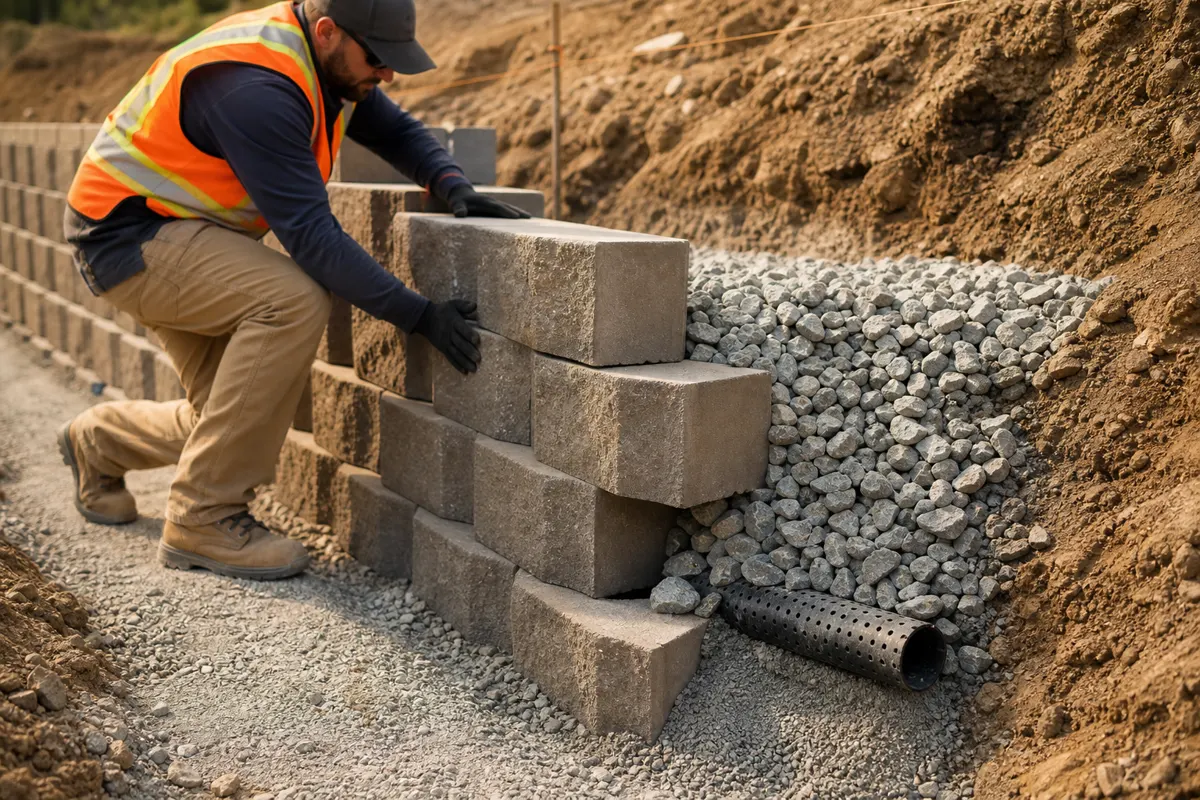
Retaining-wall cross-section
- 1Wall blocks
- 212 in drainage rock
- 3Drain pipe
- 4Compacted base trench
How to use this calculator
Read full measuring guide Measure, verify, and order
Measure the wall face, retained height, drainage zone thickness, and base trench separately.
Confirm the drainage-zone thickness.
Add optional base trench rock.
What each input means
Wall length
Total wall length along the face.
Unit: ft or m. Measure along straight sections and add them together.Wall height
Backfilled wall height used for drainage rock.
Unit: ft or m. Measure from base grade to retained grade.Drainage-zone thickness
Depth of clean stone behind the blocks.
Unit: ft or m. Measure straight back from the rear of the wall units.Base trench width
Width of the compacted base trench.
Unit: ft or m. Measure the excavated trench width below the first course.Base trench depth
Depth of the base trench stone.
Unit: ft or m. Measure finished compacted base thickness in feet.Wall-rock density
Bulk density for clean wall rock.
Unit: lb/ft3 or kg/m3. Use supplier density for the selected drainage aggregate.Extra / waste
Percent added for cuts, spillage, edge cleanup, and small estimating errors.
Unit: percent. Use 5 percent for simple square work and 10 percent or more for irregular work.Price per ton
Optional supplier price used to estimate material cost before delivery fees and taxes.
Unit: USD per US ton. Enter the quoted material price per US short ton. Leave 0 if you only need quantity.Check the calculation
Example: a 30 ft wall, 3 ft high, with a 1 ft drainage zone uses 90 cubic feet before waste.
A 30 ft wall with a 1 ft drainage zone behind a 3 ft wall needs 3.33 cubic yards before allowances.
Total loose order 4.89 cu yd Total weight 6.60 US tons
Drainage rock = wall length x wall height x zone thickness. Base = length x trench width x trench depth.
Assumptions to check
- Use clean, angular drainage aggregate specified by the wall system.
- Exclude the volume occupied by drain pipe only when material quantities justify it.
- Wall engineering and drainage design are outside this estimating tool.
- Does not replace engineered retaining wall design.
- Does not size geogrid, pipe, or outlet.
- Curved walls may need extra allowance.
Read our formulas, sources, image credits, and review policy
Frequently Asked Questions
What does this retaining wall backfill calculator calculate?
It uses project-specific inputs and the formula shown below. Drainage rock = wall length x wall height x zone thickness. Base = length x trench width x trench depth.
Are the presets exact specifications?
No. Presets are editable planning starting points. Confirm depths, materials, and densities with the supplier, manufacturer, or project designer.
Why can delivered weight differ?
Bulk density varies by supplier and moisture level. Moisture, gradation, compaction, and scale accuracy can change the delivered weight.