Measure finished length and width.
Plan the aggregate below your pavers with allowances for compaction and jobsite waste. The calculator measures the compacted aggregate base and the 1-inch bedding-sand layer separately in one estimate.
Verified formulaEditable presetsUS + metric
Purpose-built estimator
Project measurements
The finished long side of the paved area.
The finished short side of the paved area.
Changes the starting base depth for pedestrian or vehicle loads.
Final compacted thickness of the aggregate base.
Screeded sand layer above the compacted base.
Planning bulk density for road base or crushed aggregate.
Planning bulk density for bedding sand.
Loose aggregate ordered above compacted volume.
Percent added for cuts, spillage, edge cleanup, and small estimating errors.
Optional supplier price used to estimate material cost before delivery fees and taxes.
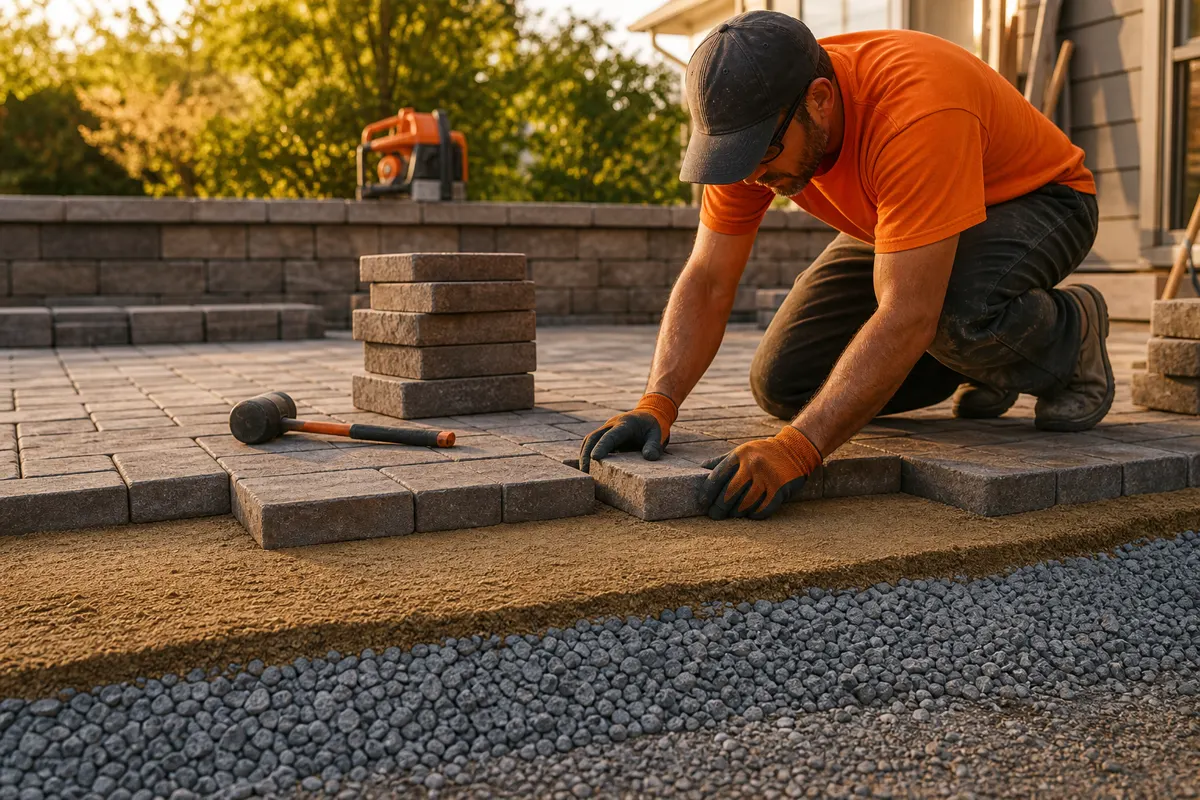
Paver system cross-section
- 1Pavers
- 21 in bedding sand
- 3Compacted aggregate base
- 4Prepared subgrade
How to use this calculator
Read full measuring guide Measure, verify, and order
Measure the finished paved footprint, then build the estimate as two layers: compacted aggregate base and bedding sand.
Confirm base and bedding-sand depths.
Order base and sand as separate materials.
What each input means
Project length
The finished long side of the paved area.
Unit: ft or m. Hook the tape at one finished edge and measure to the opposite edge.Project width
The finished short side of the paved area.
Unit: ft or m. Measure perpendicular to length. For curves, split the project into rectangles.Use preset
Changes the starting base depth for pedestrian or vehicle loads.
Pick the closest use, then adjust depths to your local specification.Compacted base depth
Final compacted thickness of the aggregate base.
Unit: in or cm. Measure planned depth after excavation, before bedding sand.Bedding sand depth
Screeded sand layer above the compacted base.
Unit: in or cm. Most interlocking paver guidance starts with about 1 inch of bedding sand.Base density
Planning bulk density for road base or crushed aggregate.
Unit: lb/ft3 or kg/m3. Use your supplier density if available.Sand density
Planning bulk density for bedding sand.
Unit: lb/ft3 or kg/m3. Use dry, damp, or supplier density depending on how it is sold.Base compaction allowance
Loose aggregate ordered above compacted volume.
Unit: percent. Use the supplier or installer shrinkage allowance.Extra / waste
Percent added for cuts, spillage, edge cleanup, and small estimating errors.
Unit: percent. Use 5 percent for simple square work and 10 percent or more for irregular work.Price per ton
Optional supplier price used to estimate material cost before delivery fees and taxes.
Unit: USD per US ton. Enter the quoted material price per US short ton. Leave 0 if you only need quantity.Check the calculation
Example: a 12 ft by 16 ft patio with 6 inches of base and 1 inch of bedding sand is calculated as two rectangular layers.
A 12 × 16 ft patio with a 6-inch compacted base contains 3.56 cubic yards before compaction and waste allowances.
Total loose order 5.00 cu yd Total weight 8.51 US tons
Area = length x width. Base volume = area x base depth. Sand volume = area x sand depth.
Assumptions to check
- Use 4–6 inches for pedestrian patios and deeper bases for vehicles or weak soil.
- Bedding sand is normally a separate, approximately 1-inch layer.
- Local frost and drainage conditions can change the required base.
- Not a pavement engineering design.
- Does not size edge restraint or geotextile.
- Confirm base depth in freeze-thaw regions.
Read our formulas, sources, image credits, and review policy
Frequently Asked Questions
What does this paver base calculator calculate?
It uses project-specific inputs and the formula shown below. Area = length x width. Base volume = area x base depth. Sand volume = area x sand depth.
Are the presets exact specifications?
No. Presets are editable planning starting points. Confirm depths, materials, and densities with the supplier, manufacturer, or project designer.
Why can delivered weight differ?
Road base is commonly about 130 lb/ft³, while bedding sand is typically lighter. Moisture, gradation, compaction, and scale accuracy can change the delivered weight.