Measure finished pad size.
Calculate the aggregate needed for a parking area using finished pad dimensions, compacted depth, waste, and compaction allowances.
Verified formulaEditable presetsUS + metric
Purpose-built estimator
Project measurements
Finished parking pad length.
Finished parking pad width.
Sets starting base and surface depths.
Compacted aggregate base depth.
Top gravel wearing layer depth.
Bulk density for road base or crusher run.
Bulk density for surface gravel.
Loose material added to achieve compacted layers.
Percent added for cuts, spillage, edge cleanup, and small estimating errors.
Optional supplier price used to estimate material cost before delivery fees and taxes.
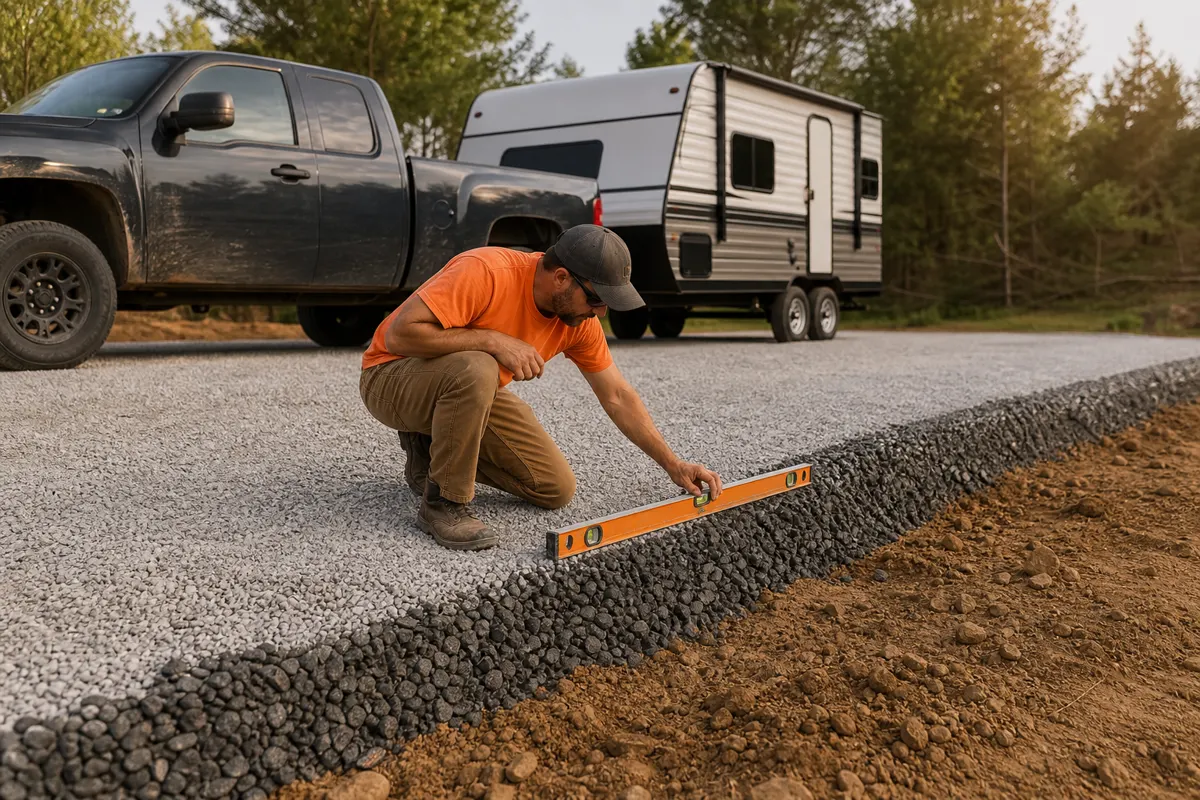
Parking-pad cross-section
- 1Surface gravel
- 2Compacted aggregate base
- 3Prepared subgrade
- 4Drainage fall
How to use this calculator
Read full measuring guide Measure, verify, and order
Measure the full pad footprint and estimate base and surface layers separately.
Choose vehicle preset.
Review base, surface, and combined totals.
What each input means
Pad length
Finished parking pad length.
Unit: ft or m. Measure bumper-to-bumper parking space plus access clearance.Pad width
Finished parking pad width.
Unit: ft or m. Measure the full usable width including door clearance.Vehicle preset
Sets starting base and surface depths.
Pick the closest loading use, then edit depths as needed.Base depth
Compacted aggregate base depth.
Unit: in or cm. Measure planned structural base thickness.Surface gravel depth
Top gravel wearing layer depth.
Unit: in or cm. Measure finished loose or compacted surface layer thickness.Base density
Bulk density for road base or crusher run.
Unit: lb/ft3 or kg/m3. Use supplier density for base material.Surface density
Bulk density for surface gravel.
Unit: lb/ft3 or kg/m3. Use supplier density for top-course gravel.Compaction allowance
Loose material added to achieve compacted layers.
Unit: percent. Use the installer or supplier shrinkage allowance.Extra / waste
Percent added for cuts, spillage, edge cleanup, and small estimating errors.
Unit: percent. Use 5 percent for simple square work and 10 percent or more for irregular work.Price per ton
Optional supplier price used to estimate material cost before delivery fees and taxes.
Unit: USD per US ton. Enter the quoted material price per US short ton. Leave 0 if you only need quantity.Check the calculation
Example: a 12 ft by 24 ft pad with 6 inches of base and 2 inches of surface is calculated as two layers.
A 12 × 24 ft parking pad at 6 inches deep contains 5.33 compacted cubic yards before allowances.
Total loose order 8.69 cu yd Total weight 14.37 US tons
Each layer volume = pad length x pad width x layer depth. Delivery total is the sum of both layers.
Assumptions to check
- Soft subgrade and heavy vehicles may require a deeper engineered section.
- Calculate separate base and surface layers when different materials are used.
- Provide drainage and edge restraint appropriate to the site.
- Does not design for subgrade strength.
- Does not include excavation haul-off.
- RV pads may need engineering or thicker sections.
Read our formulas, sources, image credits, and review policy
Frequently Asked Questions
What does this parking pad gravel calculator calculate?
It uses project-specific inputs and the formula shown below. Each layer volume = pad length x pad width x layer depth. Delivery total is the sum of both layers.
Are the presets exact specifications?
No. Presets are editable planning starting points. Confirm depths, materials, and densities with the supplier, manufacturer, or project designer.
Why can delivered weight differ?
Bulk density varies by supplier and moisture level. Moisture, gradation, compaction, and scale accuracy can change the delivered weight.