Measure rise/run or slope length.
Use measured surface length and width with the specified average rock layer thickness. Density and void space vary substantially with riprap size.
Verified formulaEditable presetsUS + metric
Purpose-built estimator
Project measurements
Choose how you measured the sloped face.
Flat horizontal distance from top to toe.
Vertical height change of the slope.
Width of the slope or channel segment.
Average stone layer thickness.
Optional buried toe trench width.
Optional buried toe trench depth.
Bulk density including voids between larger stones.
Percent added for cuts, spillage, edge cleanup, and small estimating errors.
Optional supplier price used to estimate material cost before delivery fees and taxes.
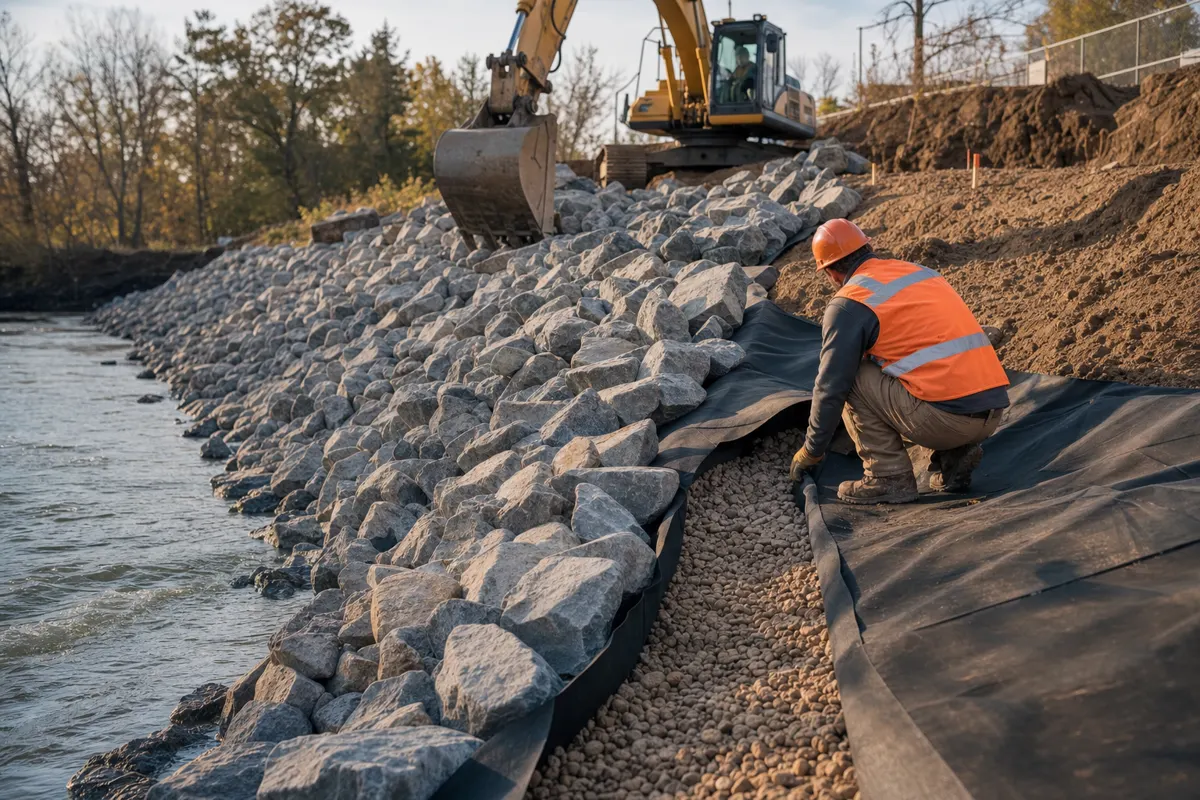
Riprap slope section
- 1Slope surface length
- 2Riprap thickness
- 3Filter layer
- 4Optional toe trench
How to use this calculator
Read full measuring guide Measure, verify, and order
Measure the actual sloped surface, not just the flat map distance, then add specified thickness and toe trench volume.
Enter protected width and thickness.
Add toe trench if specified.
What each input means
Slope measurement
Choose how you measured the sloped face.
Use rise/run when you cannot safely measure along the slope.Horizontal run
Flat horizontal distance from top to toe.
Unit: ft or m. Measure on plan view or level ground projection.Vertical rise
Vertical height change of the slope.
Unit: ft or m. Measure elevation difference from toe to top.Slope surface length
Actual measured distance along the slope face.
Unit: ft or m. Lay a tape along the slope surface if safe.Protected width
Width of the slope or channel segment.
Unit: ft or m. Measure across the protected area.Riprap layer thickness
Average stone layer thickness.
Unit: in or cm. Use the project specification or stone size requirement.Toe trench width
Optional buried toe trench width.
Unit: ft or m. Enter 0 if no toe trench is used.Toe trench depth
Optional buried toe trench depth.
Unit: ft or m. Measure vertical trench depth in feet.Riprap bulk density
Bulk density including voids between larger stones.
Unit: lb/ft3 or kg/m3. Use supplier or specification value when available.Extra / waste
Percent added for cuts, spillage, edge cleanup, and small estimating errors.
Unit: percent. Use 5 percent for simple square work and 10 percent or more for irregular work.Price per ton
Optional supplier price used to estimate material cost before delivery fees and taxes.
Unit: USD per US ton. Enter the quoted material price per US short ton. Leave 0 if you only need quantity.Check the calculation
Example: a 12 ft run and 5 ft rise creates a 13 ft slope length before multiplying by width and thickness.
A 30 × 10 ft area with a 12-inch layer contains 11.11 cubic yards before allowances.
Total loose order 10.59 cu yd Total weight 14.30 US tons
Slope length = sqrt(run^2 + rise^2). Riprap volume = slope length x protected width x thickness.
Assumptions to check
- Measure along the slope surface, not only the horizontal run.
- Use the thickness required by the project design.
- Erosion-control sizing should be confirmed by a qualified designer.
- Does not size stone for water velocity.
- Does not replace NRCS or engineer specifications.
- Unsafe slopes should be measured from plans.
Read our formulas, sources, image credits, and review policy
Frequently Asked Questions
What does this riprap calculator calculate?
It uses project-specific inputs and the formula shown below. Slope length = sqrt(run^2 + rise^2). Riprap volume = slope length x protected width x thickness.
Are the presets exact specifications?
No. Presets are editable planning starting points. Confirm depths, materials, and densities with the supplier, manufacturer, or project designer.
Why can delivered weight differ?
Riprap bulk density varies with gradation, placement, and void space; use supplier data when available. Moisture, gradation, compaction, and scale accuracy can change the delivered weight.