Use average depth when the ground tapers from shallow to deep instead of assuming one uniform depth.
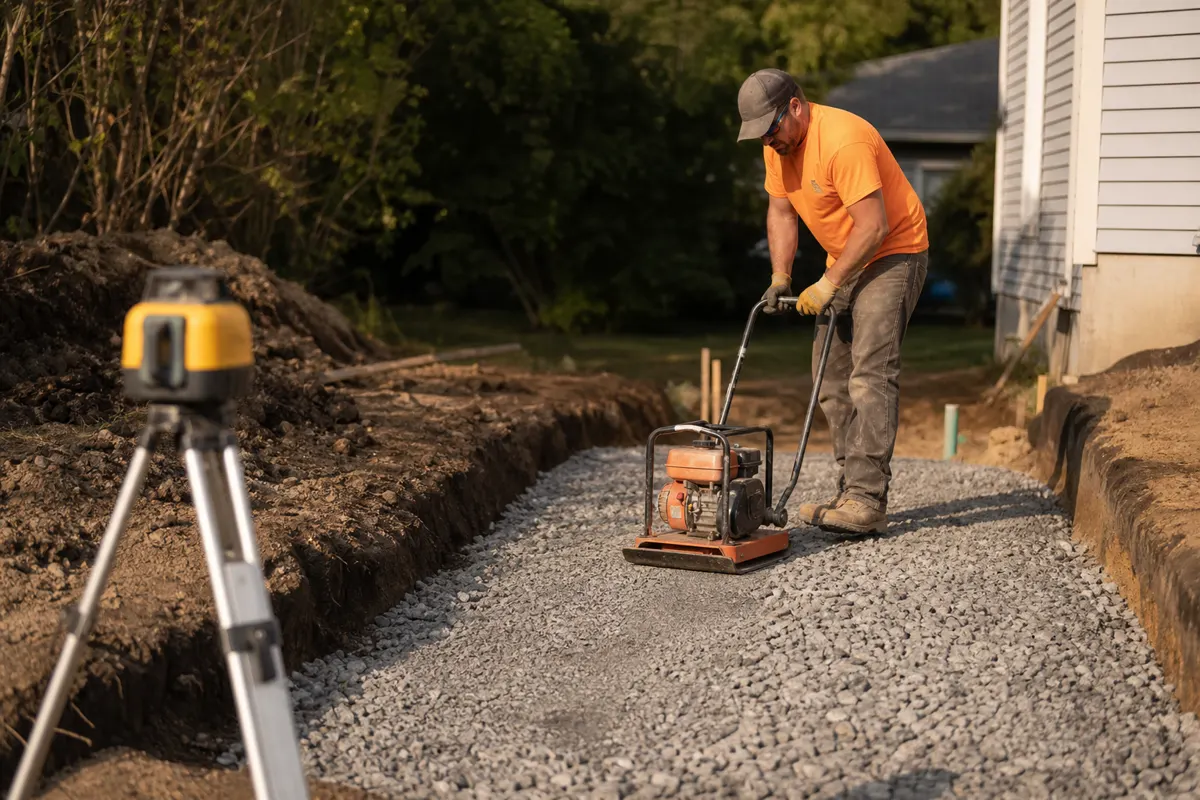
Tools to have ready
- Tape measure
- Straight board
- Grade stakes
- Marker flags
- Notebook
How to take the measurements
Mark the boundary of the fill area.
Measure length and width or calculate square footage from a sketch.
Place a straight board or string at finished grade.
Measure the shallowest and deepest gaps beneath that line.
Use the calculator average depth and add waste or compaction.
Tapered fill measurement
- 1Minimum depth
- 2Average depth
- 3Maximum depth
- 4Finished grade
How the calculator works
Average depth = (minimum depth + maximum depth) / 2. Volume = area x average depth.
Example: a 20 ft by 12 ft area with 2 inch and 6 inch depths uses a 4 inch average depth.
What every field and unit means
Area input
Choose a rectangle or enter square footage from a sketch.
Use measured area for irregular shapes.Fill length
Length of the fill area.
Unit: ft or m. Measure the longest side of the fill zone.Fill width
Width of the fill area.
Unit: ft or m. Measure perpendicular to length.Measured area
Total square feet from a drawing or irregular-area calculation.
Unit: sq ft or m2. Break irregular zones into simple shapes and add them.Minimum depth
Shallowest planned fill depth.
Unit: in or cm. Probe or measure from finished grade to current grade.Maximum depth
Deepest planned fill depth.
Unit: in or cm. Measure the deepest point of the low area.Fill density
Bulk density for the chosen fill aggregate.
Unit: lb/ft3 or kg/m3. Use supplier density when available.Compaction allowance
Extra loose material needed to reach compacted grade.
Unit: percent. Use a reasonable shrinkage allowance for compacted lifts.Extra / waste
Percent added for cuts, spillage, edge cleanup, and small estimating errors.
Unit: percent. Use 5 percent for simple square work and 10 percent or more for irregular work. Do not enter 0 when the shape has curves, tapers, or hand trimming.Price per ton
Optional supplier price used to estimate material cost before delivery fees and taxes.
Unit: USD per US ton. Enter the quoted material price per US short ton. Leave 0 if you only need quantity.Assumptions and limits
- Average depth is a planning shortcut for tapered fill.
- Deep structural fill should be placed in compacted lifts.
- Soil stabilization is outside this calculator.
- Average depth may understate highly irregular holes.
- Does not evaluate bearing capacity.
- Use engineered fill for structural loads.
Research basis: FHWA granular base guidance, NIST unit conversions. Full methodology and image-credit notes are maintained on the Editorial Policy page.